If you stepped outside today in Queen Creek, Gilbert, or Mesa, you probably felt like you walked directly into a pre-heated oven. Welcome to June in the East Valley. We’ve officially hit that 111°F mark, and while you’re hiding inside with the AC cranked to 72, your pool is out there taking a beating from the relentless Arizona sun.
I’ve spent over 21 years looking at water in this valley, and I can tell you that a heatwave like this is where "good enough" pool care goes to die. If your chemistry is slightly off or your pump isn't running long enough, you won’t just have a warm pool: you’ll have a green swamp by Monday morning.
Maintaining a pool in the Arizona desert isn't rocket science, but it does require a bit of local "know-how" that the big corporate manuals don't always cover. Let's talk about how to keep your water blue and your equipment from melting during this 2026 heatwave.
The Chemistry Crisis: Why Your Chlorine Disappears
In 111-degree weather, the sun isn't just a nuisance; it’s a chemical vacuum. The UV index in San Tan Valley and Chandler during June is high enough to strip an unprotected pool of its chlorine in just a few hours.
Sunscreen for Your Water
This is where Cyanuric Acid (CYA), often called "stabilizer," comes into play. Think of CYA as sunscreen for your chlorine. Without it, the sun burns off your sanitizer almost instantly. However, there’s a catch: too much CYA (which often happens if you use too many chlorine tabs) makes your chlorine ineffective.
Measure free chlorine and pH alongside cyanuric acid when diagnosing persistent sanitizer problems. CYA affects disinfection, but a single threshold is not a universal point where all chlorine becomes useless. Hardness and total dissolved solids are different measurements. Do not diagnose from a “chlorine lock” slogan or assume that draining is automatically required; get qualified advice on water replacement. CDC guidance.
pH and the Evaporation Trap
Arizona water is notoriously "hard." As the 111°F heat causes massive evaporation: sometimes up to half an inch a day: the minerals stay behind. This causes your pH to skyrocket. High pH (anything over 7.8) makes your chlorine about 50-70% less effective. To keep that water blue, you need to keep your pH in the 7.4 to 7.6 range.

Pump Run Times: The "1 Hour per 10 Degrees" Rule
One of the most common questions I get at Complete Aquatic Solutions is: "Jeff, how long should I run my pump?"
Set pump speed and schedule from the actual pool and equipment requirements. Confirm adequate flow for filtration, sanitizer, heater and cleaner before lowering speed. No universal air-temperature formula or number of operating hours proves sanitation. Inspect flow, filter condition and water-test results, and use the exact model instructions or qualified assistance. Pentair servicing guidance.
When to Run the Pump
Don't run your pump during the heat of the day (noon to 4 PM) if you can avoid it. Not only is the electricity more expensive during peak hours, but your equipment is already struggling with the ambient heat.
If you have a Pentair IntelliCenter or EasyTouch system, schedule your primary high-speed cleaning for the early morning (4 AM to 9 AM) and perhaps a secondary skim in the late evening. Moving water stays cooler and distributes chemicals more evenly, preventing "dead spots" where algae loves to bloom.
Equipment Survival: Don't Let Your Pump Melt
The air is 111°F, but the temperature inside your pump motor can easily exceed 140°F. If your equipment is sitting on the west side of your house in Mesa or Gilbert without any shade, you are literally cooking your seals and bearings.
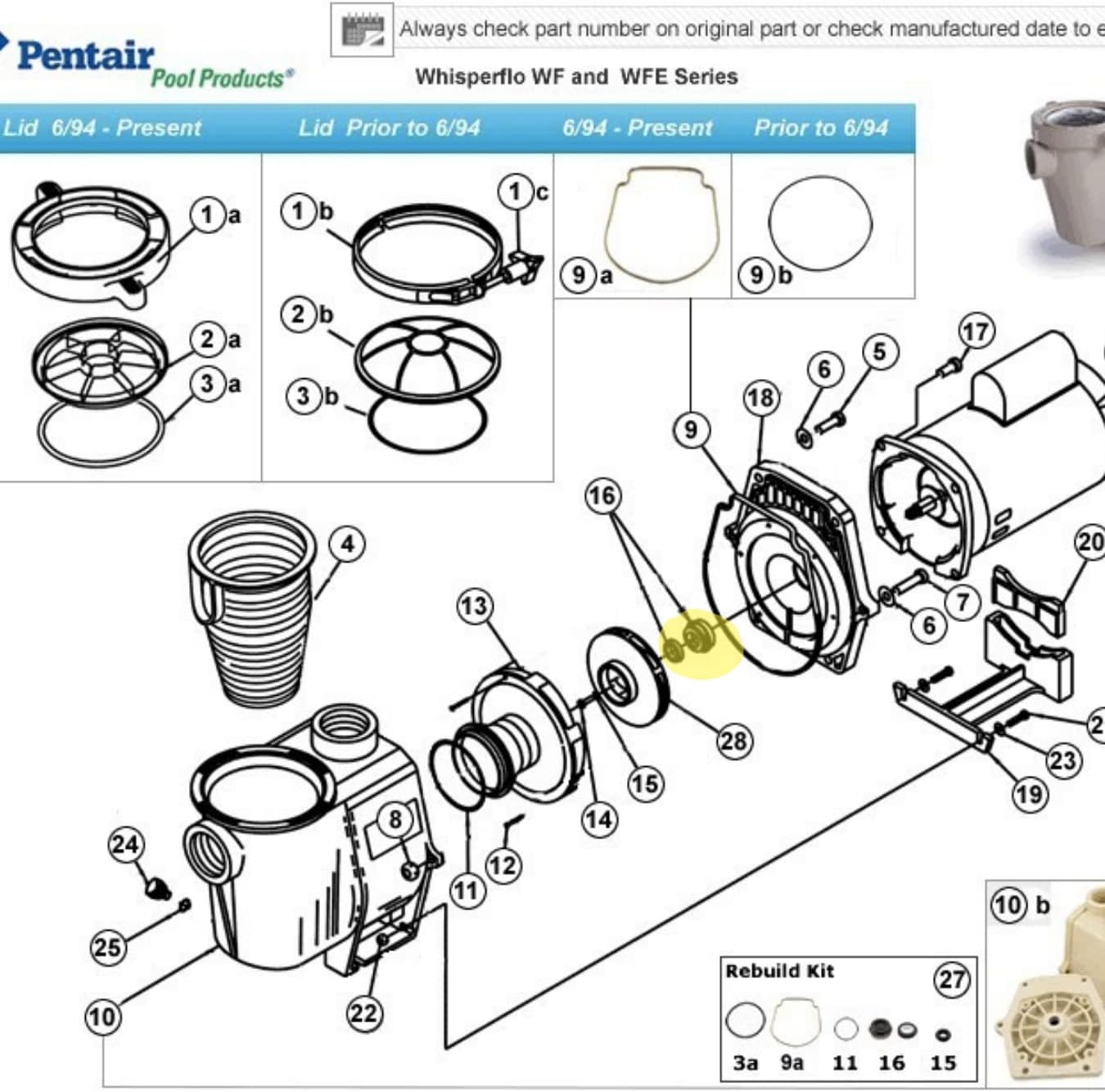
As a Pentair specialist, I see a lot of "Whisperflo" and "IntelliFlo" pumps that fail prematurely because of the heat. Look at the diagram above: those seals (Part #16) and the impeller are sensitive to heat. If your pump starts making a high-pitched screaming sound, your bearings are likely failing due to heat-thinned grease.
Ask the Tech Tip: If you can, build a simple vented cover or install a "Cool My Pool" shade for your equipment. If your motor looks like the one below: corroded and heat-damaged: you’re on borrowed time.

The Haboob Hangover: Dealing with Dust
We can't talk about June in the East Valley without mentioning the wind. Those pre-monsoon dust storms (haboobs) can dump ten pounds of fine silt into your pool in twenty minutes.
When a storm hits:
- Empty the baskets immediately: Don't let the pump starve for water because a basket is full of mesquite leaves.
- Compare pressure with the recorded clean baseline at the same pump speed, and use the exact filter model’s cleaning trigger. A universal pressure increase does not apply to every filter. Identify whether the filter is cartridge, sand or DE before service; cartridge filters are not backwashed. Follow shutdown, pressure-relief and reassembly instructions, and get qualified help if you cannot safely perform them. Pentair cartridge-filter manual example.
- Deploy the "Rebel": If you have a Pentair Rebel pool cleaner, make sure the gears aren't jammed with fine grit. These cleaners are workhorses, but Arizona dust is like liquid sandpaper.
Why "Wait and See" is a Bad Strategy
In a heatwave, a "wait and see" attitude toward a cloudy pool usually results in a $1,500 "drain and acid wash" bill. If your water looks a little dull today, it will be green tomorrow.
We specialize in commercial pool service for HOAs and apartments, but we bring that same "fail-safe" mentality to our residential customers. Whether you need equipment troubleshooting or just a repair estimate, getting ahead of the problem is the only way to save money in the long run.

Professional Results for DIYers
I love helping DIYers. You don't always need a full-service tech to come out to your house in Queen Creek just to tell you your chlorine is low. But sometimes, you run into a problem you can't solve: like a mysterious leak or an automation system that won't turn on.
That’s why we created the Virtual Service Call.
Instead of paying a $150+ "show-up fee" just to have a guy stand in your yard for five minutes, you can use our Virtual Technician service. You upload photos and videos of your equipment or your green water, and I’ll give you a real, professional diagnosis. I’ll tell you exactly what’s wrong and how to fix it: or if it’s something that truly requires a licensed pro to handle.
Summary Checklist for the 111°F Heatwave:
- Check free chlorine and pH at least twice daily and more often with heavy swimming, using a suitable kit according to its instructions. Weekly service or clear-looking water does not establish conditions between checks. CDC home-pool testing guidance.
- Target pH: 7.4 to 7.5.
- Set pump speed and schedule from the actual pool and equipment requirements. Confirm adequate flow for filtration, sanitizer, heater and cleaner before lowering speed. No universal air-temperature formula or number of operating hours proves sanitation. Inspect flow, filter condition and water-test results, and use the exact model instructions or qualified assistance. Pentair servicing guidance.
- Water Level: Check daily. If it drops below the skimmer, your pump will burn out.
- Brush: Twice a week. Even if you don't see algae, it's there.
Don't let the Arizona heat win. Keep your water moving, keep your chemicals balanced, and if you get stuck, reach out to us. We’re your local experts for Chandler pool service, Mesa pool cleaning, and everything in between.
Stay cool out there!
: Jeff Niegsch
Owner, Complete Aquatic Solutions